TL;DR
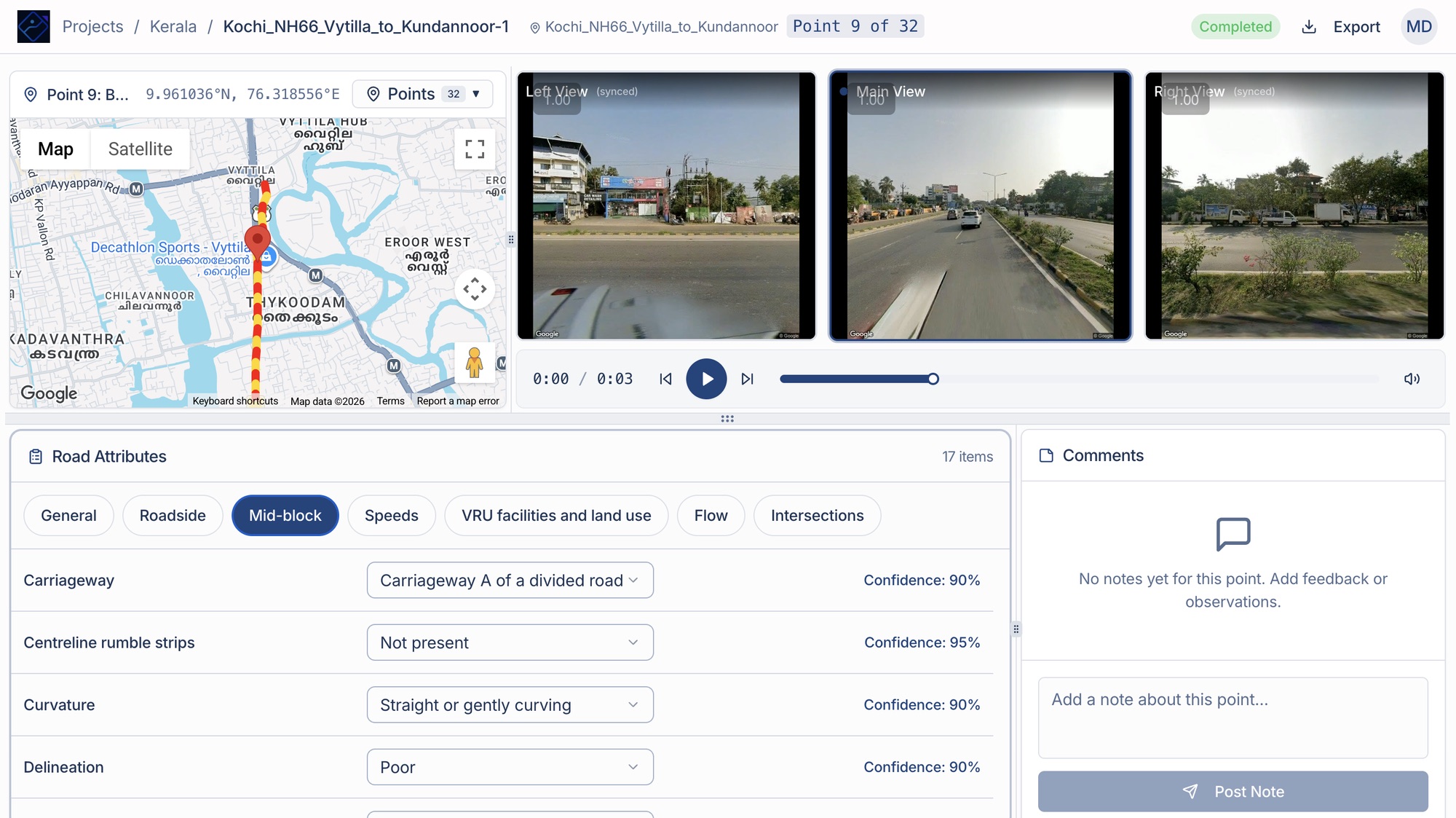
Road-quality assessment is done by auditors, by hand, on the road. RoadAssess replaces the manual pass with vision models: an auditor uploads the geo-tagged footage they already capture and gets an assessment back in one click. In pilot it projects to roughly 10x faster at about half the cost. It carries an INR 1,000,000 research grant from IIT Madras, and I have been building it since October 2025.
The problem
The assessment itself is repetitive, visual, and enormous in volume, which is the exact shape of problem vision models are good at. Today it is done manually, road by road, which is slow and expensive at the scale road networks demand.
What I owned
I built this myself, self-taught and AI-assisted through Claude Code and Lovable, which I would rather say plainly than imply otherwise. I can read and debug the codebase, and that is the claim I will defend. What I built: TypeScript and React on Vite with Tailwind and shadcn/ui, hand-written Supabase migrations, and edge functions doing the queueing, transcoding and presigned uploads, tested with Vitest and Playwright. What I reused: the vision models themselves, Supabase's PostgreSQL, Python on Firebase behind it, and Google Maps for the geospatial layer.
The hard part
The obstacle was never the model. It was that any workflow demanding auditors change how they capture footage dies on contact with the field. So the constraint I set first was that the input had to be the footage auditors already produce, geo-tagged and otherwise standard, with nothing new asked of them at the roadside. Footage goes up, gets transcoded and queued, and comes back scored against the assessment criteria, with each finding pinned to where on the road it happened. Auditors work in a project and audit structure that matches how they already organize the job, so the tool slots into the existing process rather than asking anyone to adopt a new one.
Outcome
In pilot, projecting roughly 10x faster at about 50% lower cost than the manual process. Those are pilot projections and I say so every time, because a projection presented as a measured result is the fastest way to lose an audience that knows the difference. The IIT Madras grant funds the work.